

When Therapy Terms Lose Their Meaning: What "Gaslighting," "Trauma," and "Narcissism" Really Mean

Key Takeaways
Mental health awareness is helping more people seek support.
Therapy terms have specific clinical meanings.
Labels don't tell the whole story.
Focus on behaviors, not diagnoses.
Therapy provides personalized understanding and guidance.
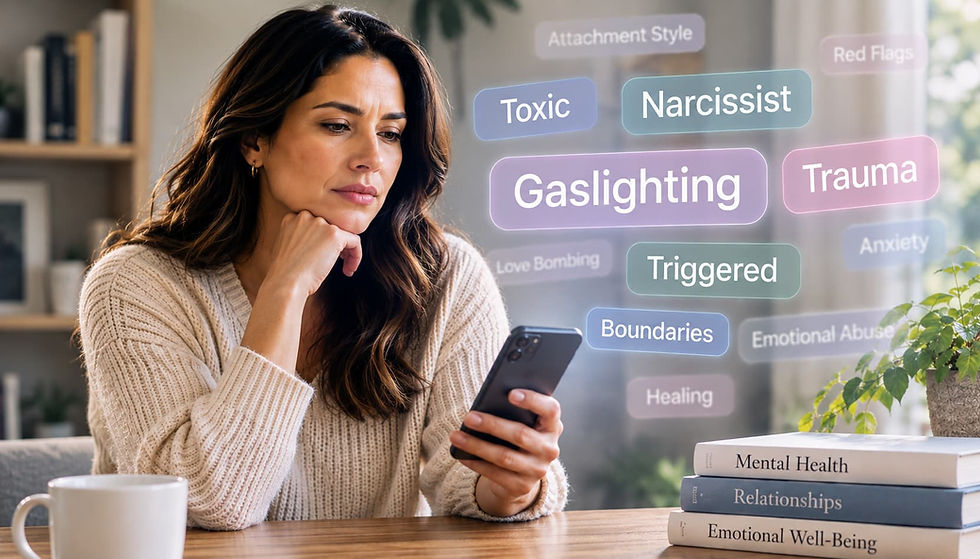
Mental health has become part of everyday conversation in ways that would have been difficult to imagine just a decade ago. Scroll through social media, listen to a podcast, or catch up with friends over coffee, and you'll likely hear words like gaslighting, trauma, narcissism, triggered, or toxic.
In many ways, this is something to celebrate. More people are talking openly about emotional well-being, recognizing unhealthy relationship patterns, and seeking support without the stigma that once surrounded therapy.
At Love Discovery Institute, we see this increased awareness as a positive step. Many clients tell us that an article, podcast, or social media post was the first thing that made them pause and wonder if they deserved something healthier.
At the same time, as therapy language becomes more common, some words begin to lose the precision that makes them meaningful. Clinical terms are designed to describe specific patterns of behavior and emotional experiences—not to settle disagreements or categorize people after a single interaction.
Understanding the difference doesn't mean policing language or criticizing people for learning online. Instead, it helps us communicate more clearly, approach relationships with greater curiosity, and know when it's time to seek professional guidance.
Why Therapy Language Is Everywhere

The rise of therapy language isn't happening by accident. Mental health professionals are sharing educational content online. Celebrities are speaking openly about counseling. Podcasts discuss attachment styles, boundaries, anxiety, and relationships. Social media platforms have made psychological concepts more accessible than ever before.
For many people, this accessibility has been life-changing. Someone who grew up believing emotional struggles should be kept private may finally realize they're not alone. Another person may recognize unhealthy patterns in a relationship and decide to seek counseling. Parents may become more aware of how their communication affects their children. Couples may begin having conversations they never knew how to start.
These are meaningful changes, and they're worth celebrating.
The challenge isn't that people are talking about mental health—it's that short videos and social media posts rarely have enough time to explain the complexity behind clinical concepts. A sixty-second clip can introduce an idea, but it can't replace the thoughtful exploration that happens in therapy.
Why Our Brains Love Labels
Our brains are fascinating. When we're confused, hurt, or overwhelmed, our brains naturally search for explanations. Having a label can provide an immediate sense of relief. It helps organize complicated emotions and gives us language for experiences that once felt impossible to describe.
Perhaps you've found yourself thinking: "Maybe I'm not imagining this."
"Maybe there's a reason I feel this way."
Those moments of recognition can be incredibly validating. However, the difficulty begins when the label becomes the entire story.
People are wonderfully—and sometimes frustratingly—complex. A single behavior rarely tells us everything we need to know about a person, just as one difficult conversation rarely defines an entire relationship. In therapy, labels are never the finish line. They're simply one piece of a much larger picture that includes personal history, family dynamics, coping skills, stress, personality, culture, and life experiences. Understanding almost always begins with curiosity rather than certainty.
When Therapy Terms Become Everyday Buzzwords

While there are many mental health terms that have found their way into everyday conversations, a few stand out because they're so frequently misunderstood. Let's take a closer look at some of the words that often appear in social media posts, podcasts, and relationship advice—and what they actually mean in a clinical setting.
Gaslighting
"Gaslighting" has become one of the most frequently used therapy terms online.
Clinically, gaslighting refers to a persistent pattern of manipulation in which one person causes another to question their own memory, perceptions, or sense of reality. It isn't simply disagreeing about what happened or remembering an event differently.
Healthy relationships can include misunderstandings. Gaslighting involves a repeated effort to distort another person's reality in ways that create confusion and dependency.
Recognizing that distinction helps us identify genuinely harmful dynamics without labeling every disagreement as emotional abuse.
Narcissism
Few words have become as misunderstood as narcissist. It's true that some people display narcissistic traits. Most of us do from time to time. We can be self-focused, defensive, or insensitive, especially during periods of stress.
That doesn't automatically mean someone has Narcissistic Personality Disorder.
A personality disorder is a clinical diagnosis that involves enduring patterns of behavior, relationships, and functioning evaluated by a qualified mental health professional. It's far more complex than occasional selfishness or confidence.
Reducing someone to a diagnosis often prevents us from seeing the whole person—and sometimes keeps us from addressing the actual relationship problems that need attention.
Trauma
The word trauma has also expanded far beyond its clinical meaning. Not every painful experience is traumatic, even though every painful experience deserves compassion.
Trauma generally refers to experiences that overwhelm a person's ability to cope and continue affecting emotional, physical, or psychological functioning long after the event has passed.
Recognizing this distinction doesn't minimize everyday hardships. Instead, it helps preserve language that accurately describes experiences with profound and lasting impact.
Triggered
Originally, being "triggered" referred to cues that activate symptoms related to trauma, such as intense fear, panic, or intrusive memories.
Today, it's often used to describe anything that feels annoying, frustrating, or upsetting. While language naturally evolves, using the term thoughtfully helps us better understand the experiences of people living with trauma-related conditions.
Toxic
Sometimes relationships truly are unhealthy. A friend may disappoint you. You might experience friction with someone at work. A parent might say something out of turn.
There are a lot of times that being around certain people can be difficult. But not every difficult person is "toxic."
Sometimes people lack communication skills. Sometimes they're grieving, overwhelmed, emotionally immature, or carrying unresolved pain. That doesn't excuse harmful behavior—but it reminds us that understanding people is often more productive than reducing them to a label.
Why Accurate Language Matters
Words shape the way we think about ourselves and the people around us. If every disagreement becomes "gaslighting" and every selfish moment becomes narcissism, it becomes harder to recognize situations that truly require specialized support.
Labels can also unintentionally increase conflict. Once someone feels diagnosed rather than understood, meaningful conversation often stops. Partners become defensive. Family members stop listening. Friends begin arguing over terminology instead of discussing what actually happened.
Describing behaviors is usually more helpful than assigning identities.
Saying, "I feel dismissed when you interrupt me," opens a conversation.
Saying, "You're a narcissist," often ends one.
Once someone feels diagnosed rather than understood, meaningful conversation often stops. Partners become defensive.
What Therapy Looks Like Behind the Scenes
One of the biggest misconceptions about therapy is that therapists spend sessions assigning diagnoses. In reality, much of therapy looks very different.
Therapists ask questions before reaching conclusions. They listen for patterns instead of isolated moments. They explore relationships, family history, coping strategies, strengths, stressors, and the context surrounding someone's experiences.
Sometimes anger is protecting grief. Sometimes withdrawal reflects anxiety rather than rejection.
Sometimes controlling behavior grows out of fear instead of malice.
None of these observations excuse harmful actions. They simply illustrate why understanding human behavior requires more than a checklist or a viral social media video. Therapy creates space to slow down, become curious, and understand the full story.
A Better Way to Talk About Mental Health

One simple shift in communication between people can improve conversations dramatically: describe behaviors before assigning labels.
For instance, instead of saying:
"They're toxic."
You might say:
"I leave our conversations feeling emotionally drained and unheard."
Instead of saying:
"She's gaslighting me."
You might say:
"She regularly denies conversations I clearly remember, and it's making me question myself."
Behavior-based language encourages understanding, creates room for healthier communication, and provides therapists with more useful information when someone decides to seek support.
Curiosity often leads to greater clarity than certainty.
Final Thoughts
The growing conversation around mental health is something worth celebrating. Greater awareness has reduced stigma, encouraged millions of people to seek therapy, and helped many recognize that healthier relationships are possible.
The next step isn't using more therapy words—it's using them with care.
Clinical terms exist to deepen understanding, not to simplify people into categories. Behind every relationship, every conflict, and every emotional struggle is a unique story that deserves thoughtful attention.
If you've found yourself wondering whether a relationship pattern is healthy, questioning your emotional experiences, or feeling uncertain about what you're going through, you don't have to figure it out alone. A conversation with a licensed therapist can offer something social media cannot: personalized guidance rooted in your individual experiences, relationships, and goals.
Sometimes the most important part of therapy isn't finding the right label. It's finally feeling understood.
Frequently Asked Questions
What does gaslighting actually mean?
Gaslighting is a repeated pattern of psychological manipulation that causes someone to question their own memories, perceptions, or sense of reality. It is more than an occasional disagreement or misunderstanding.
Is being selfish the same as being a narcissist?
No. While people can display narcissistic traits from time to time, Narcissistic Personality Disorder is a clinical diagnosis that requires a comprehensive evaluation by a qualified mental health professional.
Does every difficult experience count as trauma?
Not necessarily. Trauma refers to experiences that overwhelm a person's ability to cope and continue affecting emotional or psychological functioning over time. Difficult experiences can still be painful and deserve support, even if they are not clinically traumatic.
Why do therapists avoid making quick diagnoses?
Therapists consider patterns, history, relationships, strengths, stressors, and context before drawing conclusions. Understanding the whole person is far more important than assigning a label after one conversation.
Can social media help me recognize mental health concerns?
Yes. Educational content can increase awareness and encourage people to seek help. However, social media should be viewed as a starting point rather than a substitute for professional assessment and personalized care.
When should I talk to a therapist?
If emotional struggles, relationship patterns, anxiety, or past experiences are affecting your daily life or well-being, speaking with a licensed therapist can provide clarity, support, and practical tools for moving forward.
Introduction
305-605-LOVE
 Author | THE TEAM AT LOVE DISCOVERY INSTITUTE The Love Discovery Institute prides itself on a diverse team of highly skilled therapists and coaches dedicated to enhancing relationship and personal development. Our team members are specialized in a variety of therapeutic approaches, ensuring that we cater to the individual needs of our clients. Each professional is committed to providing empathetic, informed, and effective guidance to help individuals and couples achieve profound emotional and relational fulfillment. Services Include:
|


