

When Halloween Is Actually Scary: 7 Ways to Help Manage Halloween Anxiety in Children

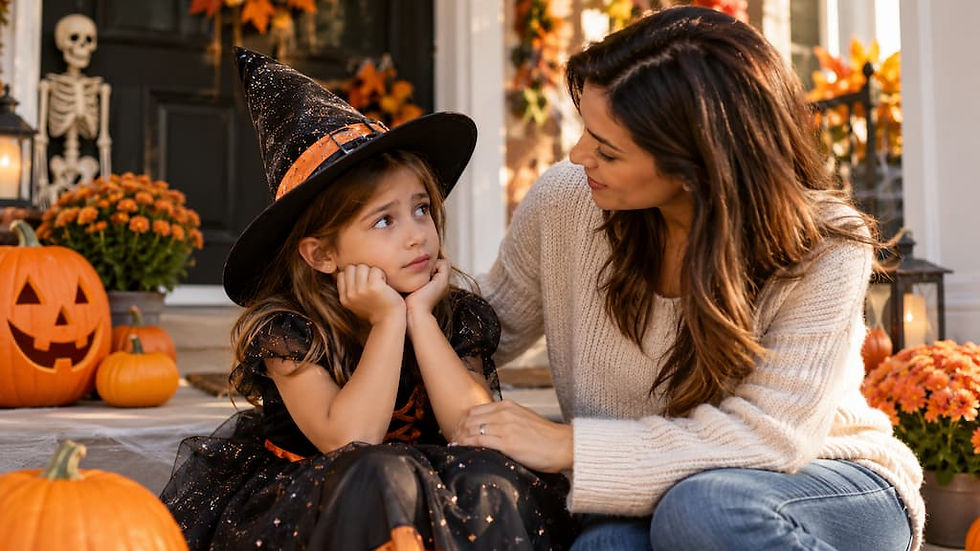
Key Takeaways
Halloween anxiety is common. Costumes, decorations, loud noises, and unfamiliar situations can overwhelm children.
Fear doesn't always indicate an anxiety disorder. Age, temperament, and sensory sensitivities influence reactions.
Validate your child's feelings. Acknowledging fears helps children feel understood and supported.
Preparation reduces anxiety. Practicing costumes and planning activities can build confidence.
Offer choices, not pressure. Encourage participation at your child's comfort level.
Persistent anxiety may require support. Consider therapy if fears interfere with everyday life.
When Halloween Fun Becomes a Source of Fear
For many families here in South Florida, Halloween is one of the most anticipated celebrations of the year. Neighborhoods from Coral Gables to Fort Lauderdale fill with decorations, kids spend weeks debating costumes, and the promise of a bucket full of candy makes October 31 especially exciting.
But not every child looks forward to it. For some, the holiday brings a heavy dose of anxiety, turning activities meant to be pure fun into moments they desperately want to avoid.
Picture taking your child to pick out a costume, only to watch them burst into tears when an animatronic skeleton suddenly roars to life in the aisle. Or maybe your little one has talked non-stop about trick-or-treating for weeks, yet the moment Halloween night arrives, they plant their feet in the entryway and refuse to walk out the front door. It’s completely normal to feel a bit baffled or even frustrated, particularly if they breezed through the exact same traditions last year.
At Love Discovery Institute, we work with parents every day who are trying to navigate these tricky childhood fears. You want your kiddo to soak up the joy of the season, but you definitely don’t want to inadvertently push them past their limit and make their anxiety flare up worse. The silver lining is that Halloween anxiety is almost always manageable when approached with a mix of patience, early prep, and a real understanding of what's ticking away underneath those fears.
Helping kids cope with Halloween anxiety doesn't require convincing them that the holiday is totally harmless. It’s about meeting them where they are, helping them label what they're feeling, and slowly building up their confidence for situations that feel a bit too big.
Why Is My Child So Afraid of Halloween?
Kids can get spooked by Halloween because flashing lights, eerie masks, booming sound effects, deep darkness, and chaotic social settings naturally trigger a defensive stress response. Little ones also process fantasy and reality right alongside each other, meaning a hyper-realistic monster or a sudden jump-scare doesn't feel like a theatrical performance—it registers as an active threat to safety.
Of course, it’s not always about literal monsters under the bed. Plenty of children get overwhelmed simply because the predictability of their day gets upended, or because sensory overload and massive crowds leave them feeling raw and fried. Figuring out the exact root of what's scaring them is always the best place to start.
Imagination and the Developing Brain

Young children experience the world through a completely different lens than adults do. During preschool and early elementary years, a vibrant imagination is essential for growth, but it also means emotionally intense inputs feel intensely real.
A five-year-old might look at a vampire cape hanging on a retail rack and giggle because they know it's just dress-up. But put someone in that exact cape rushing toward them on a dark, noisy sidewalk, and their nervous system reacts instantly. The combination of an altered appearance, abrupt movement, and collective street excitement kicks off a fight-or-flight reflex before their logical brain has a second to catch up.
Unpredictability and Loss of Control
Halloween completely transforms familiar spaces. A quiet suburban street or neighborhood block that usually feels like a secure sanctuary suddenly sprouts giant furry spiders, blinding strobe lights, artificial fog, and neighbors wearing terrifying disguises. Even familiar friends and family members can suddenly look and sound completely unrecognizable behind latex masks.
For kids who anchor themselves to routine and predictability, these abrupt shifts can cause a sharp spike in anxiety. They start running through worst-case scenarios: What if someone jumps out? What if I'm forced to walk into a crowd? What if I have to do something that makes me uncomfortable?
Instead of writing off a hesitant child as being difficult, pause and ask what feels overwhelming. Their answer will often point to a very real worry that adults would completely overlook.
For kids who anchor themselves to routine and predictability, these abrupt shifts can cause a sharp spike in anxiety. They start running through worst-case scenarios: What if someone jumps out? What if I'm forced to walk into a crowd? What if I have to do something that makes me uncomfortable?
Is Halloween Anxiety Normal in Children?
Yes, feeling uneasy about Halloween is a standard milestone for many kids. Temporary fears tied to the dark, unfamiliar faces, loud noises, or sudden surprises are a common part of growing up. These sensitivities naturally shift as kids mature and get better at decoding their environment.
A child who happily sprinted door-to-door at age four might find a specific yard display genuinely terrifying at age six. Another might sit out neighborhood activities for a couple of seasons before slowly leaning back in. Neither path points toward an underlying mental health struggle.
Understanding Age-Appropriate Fears
Preschoolers tend to struggle most with masks and decorations that blur the line between make-believe and reality. Elementary-aged kids usually grasp that characters are fictional, but they can still wrestle with acute anxiety over jump-scares, haunted setups, or getting lost in a fast-moving crowd.
Older kids and pre-teens deal with a different flavor of Halloween stress. For them, it’s rarely about monsters; it’s social pressure, fear of peer judgment, awkwardness, or just hating the sensory chaos of large group gatherings.
Every child’s baseline temperament plays a huge role here, too. Some kids crave novelty and thrills, while others thrive on quiet, predictable environments. Neither wiring is better—they're just different ways of moving through the world.
When Fear Becomes More Than a Temporary Reaction
The scale, frequency, and overall footprint of your child's anxiety matter much more than the specific thing that startled them. Being spooked by a giant yard prop is vastly different from carrying around lingering, ongoing distress that begins eating away at sleep patterns, school focus, or everyday routines.
Keep a closer eye out if your kiddo starts experiencing frequent nightmares, persistent daytime worry, somatic complaints like stomachaches before outings, or a growing pattern of avoiding ordinary situations. While these signs don't automatically mean an anxiety diagnosis, they are a gentle tap on the shoulder letting you know some extra emotional scaffolding could go a long way.
How Halloween Can Trigger Anxiety and Sensory Overload
Halloween can throw children for a loop if they are sensitive to heavy sensory input like sound, flashing light, physical touch, or dense crowds. What adults view as a festive, high-energy atmosphere can easily cross the line into sensory overload for a sensitive nervous system.
Sensory overload happens when the sheer volume of environmental data outpaces a child’s ability to comfortably process it. A kid might completely shut down from the combo of flashing strobe lights, blaring sound effects, abrasive costume fabric, and shoulder-to-shoulder sidewalks—even if none of those elements individually would break them.
Costumes, Masks, and Unexpected Sounds
Costumes come with their own set of hidden hurdles. Masks obstruct peripheral vision, muffle voices, and make it hard to read facial cues from friends. Other outfits feature scratchy tags or stiff fabrics that itch against sensitive skin.
Animatronic lawn props are another big source of distress because their timing is completely unpredictable. A child who feels totally fine looking at a stationary skeleton on a porch can get entirely derailed when it suddenly twitches, shrieks, and lunges forward.
Kids with sensory processing differences, including many neurodivergent children and kids with ADHD, often feel these impacts deeply. Even so, sensory sensitivities are common across all children, and every single kid has their own unique threshold.
Recognizing When Your Child Is Overwhelmed
Anxiety and sensory overload don't always look like traditional fear. Some children drop into tears or cling tightly to a parent's hand, while others flip toward irritability, withdrawal, complete silence, or flat-out refusal to cooperate. A child who suddenly sits down on a curb and refuses to walk another step is often physically exhausted or over-stimulated, not just acting out.
Watch for behavioral shifts when multiple high-energy stressors pile up at once. If your child is flashing warning signs of distress, pulling back to a quiet corner or heading home early is usually far more effective than trying to coax them through it.
Remember, a child doesn't need to conquer every sensory quirk on Halloween night. Swapping a restrictive costume for comfortable loungewear, skipping the loud neighborhood blocks, or staying home are completely valid choices, not acts of "giving in."
7 Ways to Help an Anxious Child Enjoy Halloween

If your kiddo dreads Halloween, the most supportive framework combines emotional validation, thoughtful staging, and room to build confidence at their own speed. The objective isn't to erase every ounce of discomfort. It's to show them they can handle a bit of uncertainty while feeling completely backed up by you.
Try these strategies to smooth out the holiday season without forcing your child past their comfort zone:
Acknowledge Their Fear Without Dismissing It:
When a child gets scared of something obvious, our default is often to swoop in with "Oh, it's just plastic, there's nothing to fear!" Though well-meaning, that phrase tells a child their internal alarm system is wrong. Instead, match their reality: "That skeleton surprised you with a loud noise, didn't it? Let's look closer—it's just a machine with a motor, it can't jump off that porch." Validating the feeling keeps trust intact while helping them ground in facts.
Introduce Halloween Decorations Gradually:
Don't wait until twilight on October 31 to throw your child into a sensory-heavy neighborhood walk. Take a calm daytime stroll earlier in the week to look at displays in the daylight. If they're curious, talk through how motion sensors or fog machines work. Letting them dictate the distance—observing from across the street first—turns an unpredictable threat into something predictable.
Practice Wearing Costumes Before Halloween:
Outfits that look incredible online often turn out to be itchy, hot, or restrictive once put into action. Let your child test-drive their costume days in advance so they can move, sit, and walk without stress. If masks are an absolute no-go, lean into face paint or a comfortable hat instead. Giving them a voice in the design keeps power in their hands.
Create a Predictable Trick-or-Treating Plan:
Uncertainty feeds anxiety. Outline the game plan before leaving the house: Which blocks are we hitting? How long are we staying out? What is our cue if we want to head home? You might agree to hit just three familiar houses on your own street before calling it a night. Practicing the knock-and-treat routine in the living room beforehand can also work wonders.
Teach Simple Calming Techniques Before Halloween:
Coping skills need to be practiced when everyone is calm, not right in the middle of a meltdown. Spend a few minutes practicing deep, slow belly breaths or playing a quick grounding game like spotting three blue things on the walk. Build a comforting mental script together, like "I can take my time, and I can always ask for a break."
Offer Less Frightening Ways to Celebrate:
Trick-or-treating is optional, not mandatory. If the crowded streets aren't a fit, pivot to other traditions: carving pumpkins in the kitchen, hosting a movie night with a gentle seasonal film, wearing a fun t-shirt to hand out candy from your own porch, or joining a "Trunk-or-Treat" group or daytime community festival, instead. Finding alternative routes lets kids participate in the joy of the season on terms that actually work for them.
Celebrate Small Steps Toward Confidence:
Ditch the scorecard that measures success by how much candy is collected. For an anxious child, walking past a scary yard display or keeping a costume on for ten minutes is a massive victory. Point out the effort objectively: "I noticed you felt nervous walking past that yard, but you tried something new anyway." Those micro-moments of resilience compound over time.
Finding the Balance Between Encouragement and Pressure

The secret lies in decoding the "why." If your child has low-level jitters but is curious about giving it a try, a short, low-pressure run to a friendly neighbor's porch can be a great confidence booster.
If they are completely dysregulated, exhausted, or overwhelmed, pivoting to a quiet home activity is the right call. You can offer a compassionate choice: "Would you like to try walking to just one house with us, or would you rather stay back and help hand out the candy bars?" This maintains boundaries while honoring their limits.
When Is Halloween Fear a Sign of Something More?
Occasional seasonal anxiety is a normal part of growing up. A startling run-in with a spooky lawn prop won't automatically trigger a lifelong phobia.
However, sometimes Halloween acts as a magnifying glass, illuminating an underlying anxiety pattern that's already operating beneath the surface. If temporary worries spill over into persistent sleep disruption, ongoing nighttime fears, or widespread avoidance, it may be time to seek an outside perspective.
Signs That Additional Support May Be Helpful
Consider consulting a child therapist or your pediatrician if you notice:
Intense nightmares or ongoing sleep disruptions that linger for weeks.
Persistent worries that don't fade after the holiday passes.
Recurring somatic symptoms like tension headaches or stomachaches tied to stress.
Reactions of distress that standard parental comfort can't soothe.
A growing pattern of avoiding school, social functions, or regular routines.
An overwhelming fear of being separated from caregivers.
Anxiety that visibly curtails your child's overall quality of life.
These signs don't automatically point to an anxiety disorder, but they do indicate that your child's nervous system is working overtime and could benefit from extra support.
Helping Children Build Confidence Beyond Halloween
While Halloween is the immediate hurdle on the calendar, the emotional skills children practice during this season pay dividends all year long. Learning to spot an emotional wave, ask for help, sit with temporary uncertainty, and tackle unfamiliar scenarios step-by-step builds true psychological resilience.
When a child successfully navigates a scary Halloween decoration, they store that data away. Later, when they face a new classroom, a tricky social dynamic, or a sudden change in family routine, they can pull from that same internal playbook. They learn an invaluable truth: feeling nervous doesn't mean you're unsafe or incapable.
Building Emotional Skills in Everyday Life
Parents can lay this groundwork year-round by making feelings a natural part of daily conversation. Don't wait until your child is actively melting down to talk about emotional states; chat about excitement, nerves, and disappointment during calm weekend moments.
Model your own stress management out loud, too. When kids watch an adult notice their own frustration, step away to take a breath, or talk through a problem, they absorb the message that difficult feelings are manageable human experiences.
Consistency matters far more than perfection. You don't need to have the flawless script ready every single time. What matters most is showing up as a steady, grounded anchor who helps them make sense of their world.
Confidence Develops Through Experience, Not Pressure
One of the most freeing realizations for a child is that courage doesn't require the total absence of fear. They can feel butterflies in their stomach, acknowledge the nerves, and still choose to take one small, manageable step forward.
That doesn't mean every fear needs immediate confrontation. Sometimes what a child needs most is deep comfort, extra predictability, or a complete change of scenery. Other times, they are ready to stretch their wings.
By balancing compassionate validation with gentle, supportive encouragement, you help your child build a quiet confidence that lasts long after the candy wrappers are thrown away.
Consistency matters far more than perfection. You don't need to have the flawless script ready every single time. What matters most is showing up as a steady, grounded anchor who helps them make sense of their world.
Conclusion: Helping Your Child Feel Safe, Understood, and More Confident

Halloween is marketed as pure fun, but for sensitive kids, the sensory blitz and unpredictable characters can feel genuinely overwhelming. When anxiety hits, parents often get caught in the tug-of-war between protecting their child and pushing them toward typical holiday milestones.
The most effective response usually lives right in the center. Acknowledging their reality, prepping them gently, and offering scaled-down ways to engage takes the sharp edges off the holiday. Simple pivots—like swapping a bulky mask for face paint or staying on your own front porch—give kids back their sense of agency.
If your child's anxiety starts coloring outside the lines of the holiday season—disrupting their sleep, straining daily routines, or keeping them from things they usually love—it may be time to partner with a professional. Here at Love Discovery Institute, our clinicians provide evidence-based tools that help kids understand their internal world while giving parents practical strategies to support them every step of the way.
If you are located in Miami or across South Florida and want to learn more about our child therapy and family counseling services, reach out to the Love Discovery Institute team today. Together, we can help your child cultivate the security, capability, and confidence they need to thrive—during Halloween and all year round.
Frequently Asked Questions About Halloween Anxiety in Children
1. Is it normal for children to be scared of Halloween?
Yes. Halloween anxiety is very common, especially among younger children who are still learning to separate fantasy from reality when faced with masks and loud props. Most seasonal fears are fleeting and soften with steady reassurance and positive exposure, though persistent distress that takes over daily routines may warrant professional guidance.
2. Why is my child afraid of Halloween decorations and costumes?
Holiday displays trigger primitive fear responses because they look unexpected, move abruptly, or blare loud noises. Younger kids genuinely struggle to distinguish theatrical props from real threats, and sensory sensitivities can turn flashing lights and heavy costumes into an uncomfortable experience.
3. How can I help my anxious child go trick-or-treating?
Map out a predictable plan ahead of time. Stick to familiar streets, head out before full dark, limit the route to just a few houses, and establish a clear exit strategy if they get overwhelmed. Practicing the routine at home beforehand can also remove a lot of the unknown.
4. Should I make my child participate in Halloween if they're scared?
Forcing a terrified child into an overwhelming holiday environment rarely helps and often backfires. However, avoiding all new experiences can unintentionally lock in fear. Look for a middle ground of emotional validation, offering choices, and encouraging tiny steps forward only when your child is ready.
5. Can Halloween cause nightmares or anxiety after the holiday?
Yes. Frightening encounters can spark temporary bedtime fears or spooky dreams, particularly for younger children. These usually settle down as normal routines resume. If sleep issues or daytime anxiety drag on and disrupt family life, it's worth checking in with a pediatrician or pediatric clinician.
6. When should I seek therapy for my child's Halloween fears?
Consider reaching out for professional support if your child's fears are severe, long-lasting, or start interfering with school, sleep, or social development. If the anxiety spills over well past Halloween into everyday life, a child therapist can help decode the patterns and equip your family with effective strategies.
Introduction
305-605-LOVE
 Author | THE TEAM AT LOVE DISCOVERY INSTITUTE The Love Discovery Institute prides itself on a diverse team of highly skilled therapists and coaches dedicated to enhancing relationship and personal development. Our team members are specialized in a variety of therapeutic approaches, ensuring that we cater to the individual needs of our clients. Each professional is committed to providing empathetic, informed, and effective guidance to help individuals and couples achieve profound emotional and relational fulfillment. Services Include:
|


